How to describe what you want to your interior designer
Ten ways clients describe the house they want. We hear them a lot, and none of them means only one thing. Here is what each one can actually mean, and the question we ask before we design from it.
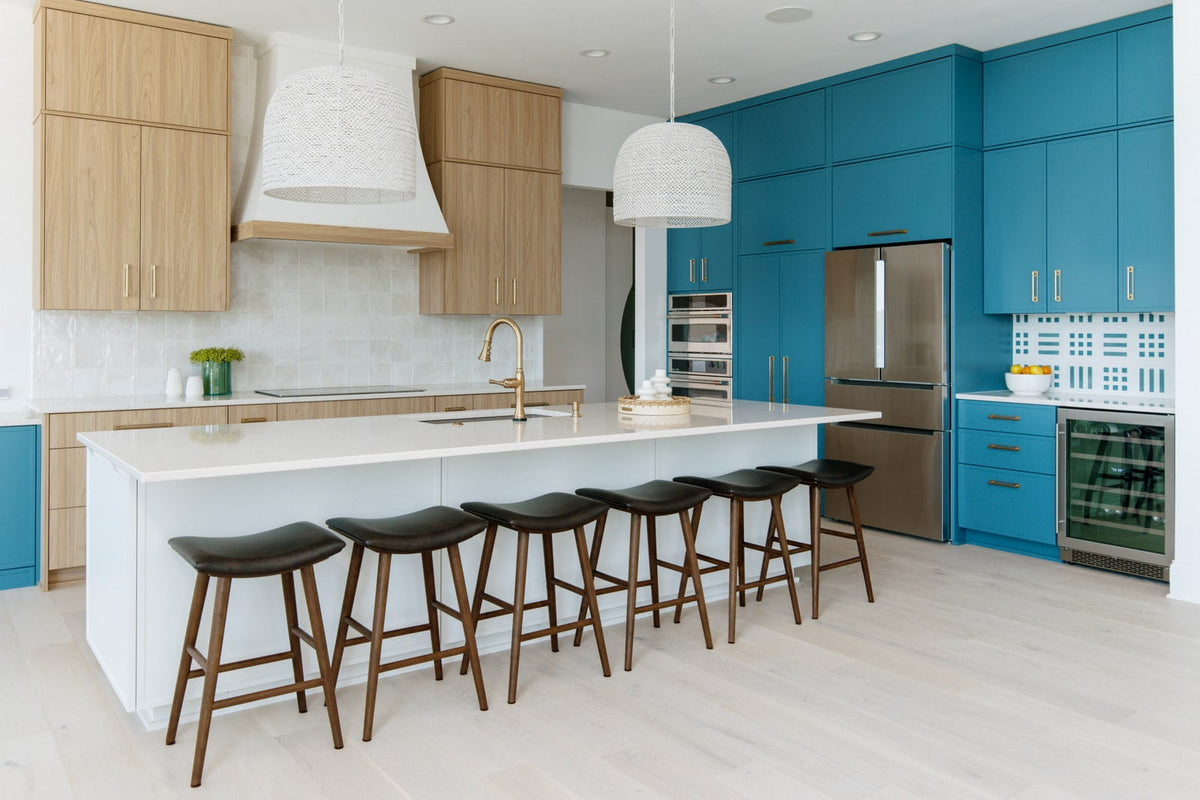
Every word below is one we hear in first meetings, and none of them means only one thing. When you tell us you want your house to feel modern or warm or cozy, we aren't trying to correct your vocabulary. We just need to understand what you mean by it.
Because the goal isn't to give your style a better label. It's to make sure the thing you get is the thing you meant.
Your words are not wrong. They are just not specific enough to order from.
"Modern"
The one that goes wrong most often, because it points at three different houses that have almost nothing in common. It can mean cool and sleek: cabinet fronts that are flat panels with no handles on them, polished concrete, a countertop that runs off the end of the island and down to the floor. It can mean warm and retro: walnut and teak, furniture up on slim tapered legs, leather, olive and mustard against the wood. Or it can mean pale and quiet: light oak, every color sitting a shade away from the one beside it, brushed steel, barely any hardware at all.
Ask yourself: cool and sleek, warm and retro, or pale and quiet?
Try saying: "Modern, but warm. Wood rather than white." Or "modern and really sleek, nothing fussy."
"Clean"
Clean can mean there is nothing on the surface: no handles anywhere, doors that sit flush with no frame showing around them, a countertop with no seam you can find. It can mean nothing is oversized: softened edges instead of sharp ones, a normal countertop thickness, paint with no shine, hardware you do not notice. Or it can mean tidy rather than bare: a simple door with a little detail in it, a modest trim where the wall meets the ceiling, more than one metal in the room.
Ask yourself: am I taking detail away, or just calming it down?
Try saying: "Clean, but I still want some warmth and detail."
"Neutral"
Neutral is not one decision, it is two, and people usually only say the first one. The first is temperature. A cool neutral room runs grey and white against chrome and black. A warm neutral room runs cream, oatmeal and tan against wood and aged brass. Both are neutral. They do not feel remotely alike when you walk in. The second decision is polish. Those same colors in polished metal and a lacquered finish read refined. In matte, with nothing reflective, they read still.
Ask yourself: is the light in the room cool or warm, and is there anything in it that catches the light?
Try saying: "Warm neutrals, and I want it calm rather than dressy."
"Light and airy"
Almost everybody who says this means one of two rooms, and they are not close. One is soft: pale washed floors, linen, cotton, woven and rattan pieces, a lot of texture and very little contrast, the kind of room you would walk into barefoot. The other is crisp: the same pale palette, but everything in it is tailored and a little formal: upholstery with sharp lines, real stripes and checks, polished metal, sharper contrast between the light and dark things in the room.
Ask yourself: soft and relaxed, or bright and tailored?
Try saying: "Light and airy, but relaxed. I don't want it to feel formal." Or the opposite, if the opposite is true.
"Warm"
This is the one where people mean three genuinely different things and use the same word for all of them. Sometimes when a client says warm, she means color: deeper browns, rust, ochre, burgundy. Sometimes she means material: wood instead of painted cabinetry, aged brass instead of chrome, leather instead of a crisp cotton. And sometimes what she is really describing is atmosphere: lamplight, layers, and a room that feels enveloping.
Ask yourself: is it the colors, the materials, or the light?
Try saying: "Warm, and I mean the materials. I want wood in here, not paint."
"Eclectic"
This one is worth knowing because the trade does not always hear what you mean by it. Many people say eclectic and mean mixing old and new, which is usually a calm, neutral, approachable room with a few pieces in it that have some history. Others say it and mean collected and handmade: earthy, layered, full of pattern, handmade pieces and things collected over time.
Ask yourself: am I describing a quiet room with a few old things in it, or a room full of pattern and texture?
Try saying: "Old and new together," if that is what you mean. The word on its own will not carry it.
"Minimal"
"Minimal, but not cold" tells us considerably more than "minimal," and it is worth understanding why. Minimal can be about quantity: almost nothing on the counter, almost nothing on the walls, and whatever is left has to earn it. Or it can be about visual noise: the room can hold plenty, as long as nothing in it is shouting. Those two rooms look nothing alike. The second one can have wood, curves and one strong color in it and still be minimal.
Ask yourself: is minimal about how much is in the room, or about how loud it is?
Try saying: "Minimal, but not cold."
"Coastal"
The sharpest pair here. Casual coastal is slipcovers you can wash, woven chairs, rattan, a sisal rug, faded blue and sheer linen at the windows. Polished coastal is tailored upholstery, crisp stripes, wide pale floors, polished nickel, everything pressed. Same water, different house.
Ask yourself: bare feet, or a pressed shirt?
Try saying: "Coastal, but casual. I want to be able to live in it."
"Rich" or "glamorous"
Both versions read expensive and they do not read the same. One announces it: symmetry, shine, strong pattern, high contrast, a room that is clearly dressed for something. The other reveals it slowly: silk and velvet, dark stone, softer metals, nothing obvious until you are sitting in it and notice that everything you are touching is good.
Ask yourself: do you want the room to announce it, or to reveal it?
Try saying: "Rich, but quiet." Or "I want it to feel like an occasion."
"Cozy"
Cozy is the one word here with no fixed meaning at all, and that is not a failure of the word. It is the most personal thing anybody tells us. Cozy has meant a deep seat you sink into. A low ceiling and a lamp. A room small enough to hear each other in. A blanket within reach of every chair.
Forget the word for a minute. Describe the last time you felt it.
What to do with all of this
If you found yourself changing the way you would describe even one of these, that is the point.
You do not need better design vocabulary. You just need to say a little more than the first word that comes to mind.
So the next time your builder, architect or designer asks what you want, don't stop at warm or modern or cozy.
Say the longer version.
The short version
Most of the words people use to describe a house point at several different houses. Modern points at three. Coastal points at two, and they are not close. You do not need better design vocabulary to fix that. You need one more sentence after the first word.
What people ask next
What is the difference between modern and contemporary?
Contemporary is one of the three houses people mean when they say modern, alongside mid-century modern and Scandinavian. It is the cool and sleek one: flat cabinet fronts, no handles showing, polished concrete.
What does transitional style mean?
It sits between traditional and contemporary, and it is what a lot of people mean when they say clean but not cold, or old and new together.
How do I tell a designer what I want if I do not know the terms?
You do not need the terms. Say the longer version of the word you already used, and answer the question a designer would have asked next.
Should I know my style before I hire an interior designer?
No. Naming it is our job. Describing what you want is the part only you can do, and one extra sentence does most of that work.
Where you are, and what we do there
If it is easier to start from pictures than from words, we built something for that. The Jeid style quiz is twenty questions, each one a choice between photographs. At the end you get a description of the style your choices point to, in the words the trade uses for it, plus the two styles close behind it. Bring that to your next meeting and your longer version is already written down.
Take the style quiz